AI for contact centers is no longer a futuristic idea. 컨택트 센터용 AI is now a practical, proven way to deliver faster, more personalized customer service while reducing operational costs and improving agent satisfaction. Organizations that explore long-tail insights on AI adoption in omnichannel contact centers gain a deeper understanding of how AI can enhance every touchpoint across channels. When implemented thoughtfully, AI becomes a powerful partner to your human team, not a replacement.
This guide explains what AI in contact centers really means, the key benefits, core capabilities, and a practical roadmap to roll it out successfully.
Beyond improving everyday interactions, AI for contact centers can transform the entire customer experience by analyzing trends and predicting needs before customers even speak to an agent. Businesses exploring innovative cloud computing solutions have found that integrating AI with scalable infrastructure significantly boosts performance and reduces downtime.
Modern AI platforms also rely on powerful processing capabilities, often supported by high-performance supercomputers that allow real-time analysis of millions of customer interactions. With this level of insight, managers can identify gaps in service and train agents more effectively, enhancing both satisfaction and retention.
For marketing and customer engagement, companies that combine AI insights with strategies for better customer acquisition and retention report stronger personalization and more meaningful interactions. AI can track trends across channels, optimize workflows, and help teams focus on solving complex issues while leaving repetitive tasks to automation.
Some organizations are taking it further, linking AI to AI-driven marketing automation platforms that connect insights directly to campaigns. This integration ensures that messaging stays consistent and relevant across email, chat, and social media, improving both conversion rates and overall brand experience.
Finally, financial institutions are using AI in contact centers to detect fraud, predict service bottlenecks, and improve compliance. Resources like top financial AI tools and guides provide practical advice on leveraging AI to optimize operations while keeping customers satisfied.
By combining these insights and tools, AI for contact centers doesn’t just streamline processes—it creates smarter, more proactive, and more human customer experiences.
Top 10 AI for Contact Centers Solutions to Transform Customer Service
In today’s fast-paced business environment, AI for contact centers is no longer optional—it’s a strategic necessity. These platforms help organizations deliver personalized experiences, reduce operational costs, and empower agents to focus on high-value tasks. Here are the top 10 solutions for AI-driven contact center excellence.
1. Bright Pattern – AI-Powered Contact Center Platform

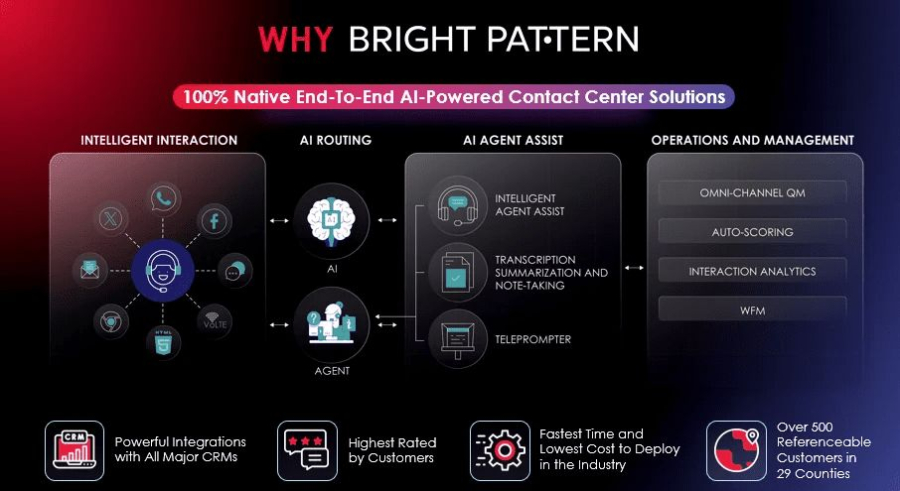
Bright Pattern leads the way in AI for contact centers with a platform designed for modern, omnichannel communication. It seamlessly integrates artificial intelligence into call center operations, enabling smarter, faster, and more personalized customer interactions.
Key features include:
- Omnichannel routing to connect customers across voice, chat, email, SMS, and social channels
- AI-powered chatbots and virtual agents to handle routine inquiries automatically
- Real-time agent assistance with AI suggestions for responses
- Comprehensive analytics to track performance and optimize workflows
- Integration with CRM and other enterprise software for a unified customer view
With Bright Pattern, businesses can implement advanced AI solutions without disrupting their existing workflows, ensuring a smooth transition and immediate ROI.
2. Genesys – Intelligent Customer Engagement
Genesys offers AI-powered contact center solutions that focus on predictive routing, virtual assistants, and workforce optimization. Their platform enhances both customer and agent experiences with advanced automation and analytics.
3. Five9 – Cloud Contact Center Software
Five9 combines cloud flexibility with AI-driven insights to improve customer engagement. Its features include AI-powered IVR, predictive dialing, and sentiment analysis to ensure agents can respond effectively.
4. NICE inContact – AI-Enhanced Cloud Solutions
NICE inContact uses AI for intelligent routing, workforce management, and customer journey analytics. Their AI tools help organizations reduce handling times while increasing customer satisfaction.
5. Talkdesk – AI Contact Center Platform
Talkdesk’s platform leverages AI to automate routine tasks, provide agent recommendations, and deliver omnichannel analytics. Its AI-driven capabilities allow contact centers to operate more efficiently and improve customer loyalty.
6. Amazon Connect – Cloud-Based Contact Center AI
Amazon Connect provides a scalable cloud contact center with AI tools such as chatbots, real-time transcription, and analytics. It enables rapid deployment of AI solutions for businesses of all sizes.
7. Cisco Contact Center – AI-Enabled Solutions
Cisco offers AI-driven contact center software focused on omnichannel communication, predictive analytics, and automated interactions, helping agents resolve issues faster and more accurately.
8. 8x8 Contact Center – Intelligent Customer Engagement
8x8 integrates AI into their cloud contact center platform to optimize routing, offer real-time agent assistance, and provide analytics dashboards for performance tracking.
9. Zendesk – AI-Driven Support Solutions
Zendesk uses AI to support agents and customers through virtual assistants, predictive analytics, and automated workflows. This reduces response times and enhances overall service quality.
10. RingCentral Contact Center – AI and Automation
RingCentral provides AI-enhanced call center solutions that streamline communication across channels, improve efficiency with automation, and deliver actionable insights for decision-makers.
What Is AI for Contact Centers?
AI for contact centersrefers to the use of technologies such as machine learning, natural language processing, and automation to assist customers and agents across phone, chat, email, and social channels. It covers everything from AI chatbots and voicebots to intelligent routing, real-time agent assistance, and automated quality monitoring.
The goal is simple: deliver better experiences for customers and agents, at a lower cost, and with more consistency.
Key Benefits of AI-Powered Contact Centers
Done well, AI can significantly improve both performance and experience. Below are the most impactful benefits organizations typically see.
1. Faster, Always-On Customer Support
- 24/7 availabilityso customers can get help at any time without waiting for business hours.
- Instant responsesfrom AI chatbots and voicebots for common questions (order status, password resets, account balances, FAQs).
- Reduced wait timesfor complex issues because AI deflects simple queries and frees agents for high-value conversations.
The result is a smoother experience: customers get quick answers to routine questions and faster access to skilled agents when they really need them.
2. Higher First-Contact Resolution
- Context-aware conversationsthat pull data from CRM, billing, or ticketing systems so customers do not have to repeat themselves.
- Dynamic knowledge suggestionsthat surface relevant articles, policies, and next-best actions for agents in real time.
- Guided workflowsthat walk agents step by step through complex processes, reducing errors and rework.
Better context and guidance mean more issues get resolved in a single interaction, boosting both efficiency and customer satisfaction.
3. Reduced Costs Without Sacrificing Quality
- Automation of repetitive taskssuch as authentication, data entry, case creation, and post-call summaries.
- Self-service containmentfor high-volume, low-complexity interactions like balance inquiries or FAQ-style questions.
- Optimized staffingthanks to accurate demand forecasting and dynamic scheduling.
These efficiencies reduce cost per contact while maintaining, and often improving, the quality of service.
4. Happier Agents, Lower Attrition
- Less repetitive workas AI handles routine queries and admin tasks that traditionally cause burnout.
- Real-time coachingthat guides agents with prompts, suggested responses, and compliance reminders during live conversations.
- Faster onboardingbecause AI tools help new hires find the right answer quickly, even with limited experience.
Instead of feeling overwhelmed, agents feel supported and empowered, driving higher engagement and lower turnover.
5. Smarter Management Decisions
- Unified analyticsacross voice, chat, email, and social interactions.
- AI-driven insightsthat highlight emerging issues, trending topics, and hidden drivers of customer satisfaction or churn.
- Objective quality monitoringthat evaluates 100% of interactions, not just a random sample.
Leaders get a clear, real-time view of what customers are saying and how the contact center is performing, making it easier to prioritize improvements that matter.
Core AI Capabilities in Modern Contact Centers
AI can enhance almost every part of a contact center. Understanding the main capabilities helps you decide where to start.
AI Chatbots and Virtual Agents
AI chatbotshandle conversations via web chat, mobile apps, and messaging channels. They can:
- Answer common questions with natural, conversational responses.
- Authenticate customers and gather key details before routing to an agent.
- Trigger workflows such as resetting passwords, updating contact details, or checking order status.
- Escalate smoothly to agents, passing full conversation history and context.
When well designed, virtual agents feel like a natural extension of your human team, not a roadblock.
Voicebots and Conversational IVR
Voice AIbrings similar capabilities to phone interactions, upgrading traditional IVR menus into conversational experiences. Customers can speak naturally instead of navigating complex keypad trees.
- Understand the customer intent from natural language, not just menu choices.
- Complete self-service tasks directly in the IVR for common requests.
- Route calls intelligently based on intent, sentiment, and business rules.
This reduces frustration, shortens handle times, and improves call containment without sacrificing experience.
Intelligent Routing and Triage
Intelligent routinguses AI to match each interaction with the best available resource, based on factors such as:
- Customer profile, value, and history.
- Issue type and complexity.
- Agent skills, experience, and performance.
- Current queues and service-level commitments.
Better routing reduces transfers, improves first-contact resolution, and ensures high-value customers receive the treatment they expect.
Agent Assist and Real-Time Guidance
Agent assisttools listen to or read the conversation in real time and provide on-screen help to agents. They can:
- Suggest responses or next-best actions based on similar resolved cases.
- Surface relevant knowledge articles or policies automatically.
- Flag potential compliance risks and prompt required disclosures.
- Summarize the conversation and auto-fill wrap-up notes at the end.
This support helps agents resolve issues faster, stay compliant, and focus their attention on the customer instead of on systems.
Quality Monitoring and Sentiment Analysis
Traditional quality assurance often reviews a small sample of interactions. WithAI-powered quality monitoring, you can evaluate nearly all calls, chats, and emails automatically.
- Transcribe and analyze conversations for sentiment, effort, and key topics.
- Detect risky behaviors or non-compliance in near real time.
- Score interactions consistently against defined quality criteria.
- Identify coaching opportunities targeted to each agent.
This allows quality teams to spend less time on manual scoring and more time on meaningful coaching and improvement.
Forecasting and Workforce Optimization
AI-driven forecastinguses historical data, seasonality, marketing campaigns, and external signals to predict future contact volumes. Combined with workforce optimization, it can:
- Create more accurate staffing plans by channel and skill.
- Automate schedule generation that balances cost and service levels.
- Adjust intraday staffing in response to unexpected spikes or lulls.
Better forecasting leads directly to smoother service and more efficient use of your team.
Real-World Use Cases of AI in Contact Centers
AI is already powering everyday experiences that customers rely on. Common use cases include:
- Banking and financial services: Balance inquiries, card activation, dispute status, loan application updates.
- Retail and eCommerce: Order tracking, returns and exchanges, product availability, loyalty program info.
- Telecommunications: Plan changes, billing questions, network outage information, simple technical troubleshooting.
- Travel and hospitality: Flight status, booking modifications, loyalty points, check-in assistance.
- Utilities: Billing, meter readings, outage reporting, appointment scheduling.
- Healthcare and insurance: Appointment reminders, claim status, coverage questions, benefit explanations.
In many of these scenarios, AI handles the initial interaction and either fully resolves the issue or seamlessly hands off to a human with complete context.
How AI Enhances the Customer Journey
AI can support customers from the moment they consider your brand to long after they become loyal advocates. The table below shows how.
|
Journey Stage |
AI Capability |
Customer Benefit |
|
Discovery |
Chatbots on websites and apps |
Instant answers to product questions and guidance to the right offering. |
|
Onboarding |
Guided workflows and proactive messaging |
Smoother setup, fewer errors, and less confusion about how to get started. |
|
Support |
Virtual agents, intelligent routing, agent assist |
Fast, accurate help through the customer’s preferred channel. |
|
Retention |
Predictive analytics and sentiment tracking |
Proactive outreach before issues escalate or customers churn. |
|
Loyalty |
Personalized offers and recommendations |
More relevant experiences that reflect history, preferences, and value. |
Implementation Roadmap: How to Get Started with AI in Your Contact Center
Implementing AI does not have to be overwhelming. A phased, outcomes-focused approach works best.
Step 1: Define Business Objectives and Success Metrics
Start by clarifying what success looks like. Common objectives include:
- Reducing average handle time or queue times.
- Increasing self-service containment for simple tasks.
- Improving CSAT, NPS, or customer effort scores.
- Reducing agent attrition or improving productivity.
- Enhancing compliance and quality consistency.
Select a small set of measurable goals and define the baseline so you can clearly demonstrate impact.
Step 2: Map Customer Journeys and Identify High-Value Use Cases
Analyze your interaction data to find:
- Top contact reasons by volume and complexity.
- Processes with heavy manual effort or frequent errors.
- Moments in the journey where customers experience friction or long waits.
Use this analysis to prioritize use cases where AI can drive quick, visible wins, such as high-volume FAQs or post-call summarization.
Step 3: Choose the Right AI Capabilities to Pilot
For an initial rollout, many organizations start with:
- AI chatbots or voicebotsfor clear, rule-based scenarios (order status, simple account info, appointment reminders).
- Agent assist toolsto support agents immediately without changing the customer experience too dramatically.
- Automated QA and analyticsto gain better visibility and insights across existing interactions.
Focus on capabilities that directly tie to your objectives and can be deployed without overhauling every system at once.
Step 4: Integrate with Core Systems
To deliver real value, AI solutions should connect with systems such as CRM, ticketing, billing, and knowledge bases. Priority integrations usually include:
- Customer datafor context and personalization.
- Case managementfor seamless handoffs and tracking.
- Knowledge managementso AI can surface accurate, up-to-date content.
Strong integration ensures AI does more than provide generic answers; it becomes a true extension of your operations.
Step 5: Launch, Measure, and Iterate
Treat AI implementation as an ongoing program, not a one-time project.
- Start with a controlled pilot or limited scope.
- Collect both quantitative metrics and qualitative feedback from customers and agents.
- Fine-tune conversation flows, routing rules, and knowledge content based on real-world usage.
- Gradually expand to new use cases and channels as confidence grows.
Change Management and Adoption Best Practices
Technology alone does not guarantee success. Adoption by agents and leaders is essential.
Engage Agents Early
- Explain clearly how AI will support them and remove low-value tasks.
- Invite frontline feedback on which processes should be automated or augmented.
- Highlight success stories where AI made an agent’s job easier or improved a customer outcome.
Provide Targeted Training
- Train supervisors on interpreting AI-driven analytics and coaching insights.
- Teach agents how to work with AI tools, such as agent assist side panels or suggested replies.
- Offer short, focused learning modules that match how people actually work.
Communicate a Clear Vision
Reassure your teams that AI is there to enhance, not replace, human expertise. Emphasize that:
- Agents remain central to complex, emotional, or high-stakes conversations.
- AI is meant to eliminate friction, not human connection.
- Career paths can expand as agents build skills in problem-solving, empathy, and digital tools.
Key KPIs to Track for AI-Enabled Contact Centers
Measuring impact is crucial to sustaining support and investment. Common KPIs include:
- Customer metrics: CSAT, NPS, customer effort score, repeat contact rate.
- Operational metrics: average handle time, first-contact resolution, transfer rate, abandonment rate.
- AI-specific metrics: containment rate for bots, successful automation rate, intent recognition accuracy.
- Agent metrics: occupancy, productivity, adherence, satisfaction, and attrition.
- Quality and compliance: percentage of interactions scored, compliance adherence, error rate.
Tracking these indicators over time helps you refine your AI strategy and demonstrate the value of your initiatives.
Future Trends in AI for Contact Centers
AI in contact centers continues to evolve rapidly. Key trends include:
- More human-like conversationsas language models become better at understanding nuance, intent, and emotion.
- Omnichannel orchestrationwhere AI maintains context across phone, chat, email, and social interactions.
- Proactive servicewith AI predicting issues before customers contact you and triggering outreach or self-healing actions.
- Deeper personalizationusing a real-time view of the customer journey, preferences, and lifetime value.
- Embedded AI in every toolso knowledge bases, CRMs, and WFM platforms all include intelligent assistants.
Organizations that build a strong AI foundation today will be better positioned to take advantage of these innovations as they mature.
Bringing It All Together
AI for contact centers offers a powerful combination of benefits: faster service, higher quality, lower costs, and more empowered agents. By starting with clear goals, focusing on high-impact use cases, and investing in change management, you can turn AI into a strategic asset for your customer experience.
Customers gain convenient, personalized support whenever they need it. Agents gain tools that make their jobs more rewarding and less repetitive. Leaders gain insight and control over performance like never before.
The opportunity is clear: with the right AI strategy, your contact center can move from a cost center to a customer experience engine that drives loyalty, efficiency, and growth.
